Quick answer
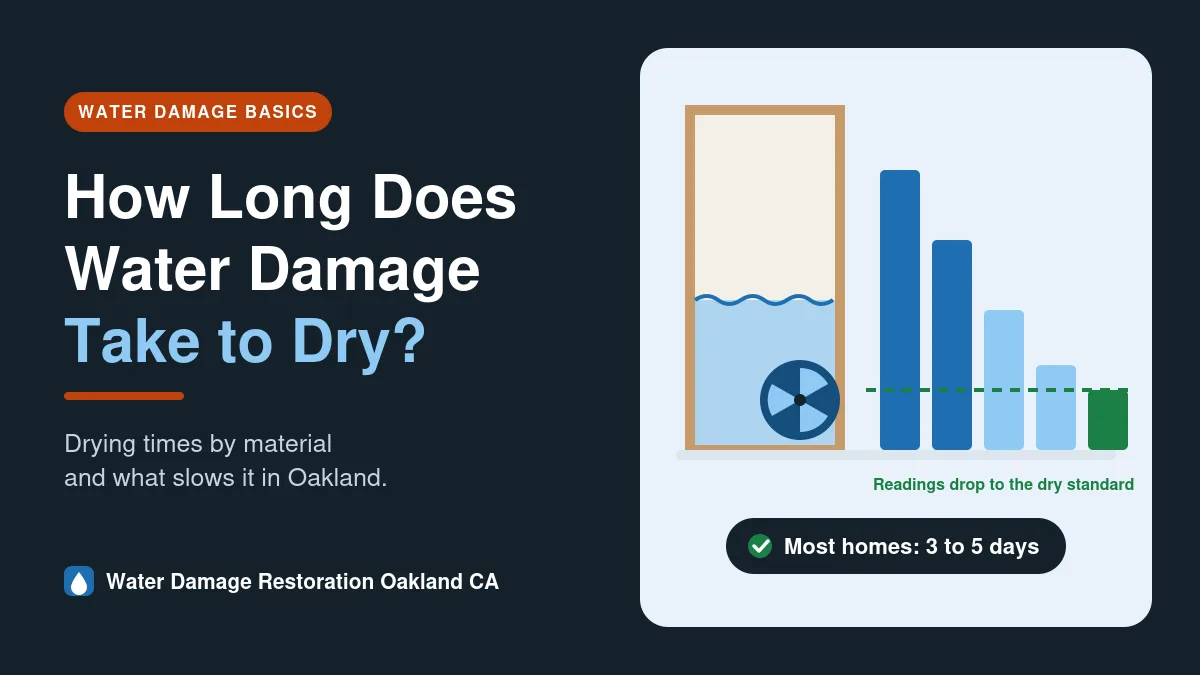
With professional drying equipment, most homes dry out from water damage in about 3 to 5 days. A small clean-water leak can be dry in 1 to 3 days. Hardwood floors, plaster walls, concrete slabs and flooded homes take longer, often 1 to 2 weeks and sometimes several weeks. The job is finished when moisture readings match the dry areas of your home, not when surfaces feel dry.
Drying time is the question every homeowner asks once the water is off. The answer depends on what got wet, how much water soaked in, and the air inside.
This guide explains how long each material takes to dry, how the IICRC water classes and categories change the timeline, how a restoration crew proves your home is dry, and why Oakland’s damp winters and older homes can add days. If the water just stopped, start with our guide on what to do in the first 24 hours.
Walls or floors still wet? Call now and get connected with a local restoration company, 24/7.
Call (925) 298-0440Key takeaways
- Most homes dry in about 3 to 5 days with extraction, air movers and dehumidifiers.
- Carpet and drywall dry fastest. Hardwood, plaster, framing and concrete can take weeks.
- Water class (how much soaked in) sets the drying time. Water category (how dirty it is) decides what must be removed.
- “Dry” means moisture readings match a dry area of the same material in your home, called the dry standard.
- The EPA says materials dried within 24 to 48 hours usually do not grow mold, so a fast start matters more than anything.
- Oakland’s wet winters, morning fog and many pre-1950 homes can stretch drying time.
How long does it take to dry water damage? Typical ranges
Restoration industry guides agree on a typical range. Most homes dry in about 3 to 5 days once professional equipment is running. The exact number depends on the water class, the materials and the weather, which the rest of this guide explains.
- Minor leak, one area: typically 1 to 3 days.
- Moderate damage, a few rooms: typically 3 to 7 days.
- Major damage or water that sat for a while: often 1 to 2 weeks or more.
- A flooded home: FEMA and the American Red Cross tell homeowners that drying could take several weeks.
Drying is not the whole repair. Rebuilding comes after the structure is dry.
Drying time by material
Thin, airy materials give up water fast. Dense ones like hardwood, plaster and concrete release it slowly. These are typical ranges with professional equipment, drawn from restoration guides and university extension advice.
| Material | Typical drying time | Speed |
|---|---|---|
| Carpet | Surface in 12 to 24 hours, with pad about 1 to 3 days | Fast |
| Drywall | 2 to 3 days with dehumidifiers, 5 to 10 days or more without | Fairly fast |
| Hardwood floors | A few days for light wetting, a week or more for soaked boards | Slow |
| Wood studs and subfloor | Can take weeks to reach 15 percent moisture or less | Slow |
| Plaster and lath | Much longer than drywall, FEMA calls it “a very long time” | Very slow |
| Concrete slab or masonry | Often 2 to 3 weeks or more to release deep moisture | Very slow |
| Wet insulation | NDSU Extension says flooded insulation holds water for months | Usually removed |
Carpet can feel dry in a day while the pad and subfloor under it are still wet. Meters, not hands, decide when drying is done.
How water class and category change the timeline
The IICRC S500 standard, the main guide restoration companies follow, sorts every job two ways. The class describes how much water soaked in and how hard it will be to evaporate. The category describes how contaminated the water is. Class drives drying time. Category drives what has to be cleaned or thrown out first.
Class 1
Least water absorbed, mostly low-porosity materials. Water is likely to evaporate with little help.
Class 2
Water flowed into the room and soaked into carpet and lower walls. A big evaporation load.
Class 3
The most absorption. Wet porous materials cover most of the walls, ceiling or floor. More equipment, longer drying.
Class 4
Deeply held or bound water in hardwood, plaster or concrete, with a low evaporation rate. Often needs special drying and the most time.
Category 1 is clean water from a supply line. Category 2 has significant contamination, like washing machine overflow. Category 3 is grossly contaminated, like sewage or outdoor floodwater. With Category 2 and 3 water, porous items such as carpet pad, drywall and insulation are often removed and the area is cleaned before drying. That adds time at the start.
What speeds up drying and what slows it down
Drying is just evaporation, helped along. Water leaves a material faster when the air around it is warm, dry and moving. Pros control all three: air movers push air across wet surfaces, dehumidifiers pull the water vapor out of the air, and temperature is kept in a range where both work well.
Speeds drying
- Removing standing water fully before drying starts.
- Low-grain refrigerant (LGR) or desiccant dehumidifiers running nonstop.
- Air movers aimed across wet walls and floors.
- Pulling up wet carpet pad and opening wet wall cavities.
- Opening windows only when the outside air is drier than inside.
Slows drying
- Fans with no dehumidifier, which just move damp air around.
- Cold rooms, where common dehumidifiers work poorly.
- Damp, foggy outdoor air let in through open windows.
- Vinyl flooring, paint or cabinets trapping water underneath.
- A slow start that lets water spread into framing and subfloor.
Answered 24/7
Want drying done right the first time?
One free call connects you with an independent, licensed restoration company in Oakland that measures moisture daily until your home is truly dry.
How pros prove your home is dry: the dry standard
A good restoration crew does not guess. On day 1 they measure the same material in a part of your home that never got wet. That reading is the dry standard. Under the S500, they set drying goals meant to return materials to normal and stop mold growth, and they keep going until the wet areas reach that goal.
Their tools: pin (penetrating) moisture meters for wood framing, subfloors and hardwood, pinless meters for drywall, plaster, tile and concrete, a thermal imaging camera to spot cool, damp areas behind walls, and a thermo-hygrometer to track temperature, relative humidity, dew point and grains per pound (GPP), which is the actual weight of water vapor in the air. Learn more about moisture detection and leak tracing.
- Day 1Map and set goals
Readings from wet and dry areas, a moisture map, and equipment placed where the water went.
- Day 2First check
The same spots are read again. Equipment is moved or added where readings are slow to drop.
- Day 3 to 4Track the trend
Air readings should show the dehumidifiers are drying the air. Fast materials like carpet and drywall often reach goal now.
- Final dayConfirm and sign off
Every point matches the dry standard, readings are logged, and only then is equipment removed.
Questions to ask the drying crew
Tick each one once you have a clear answer.
Great. Keep a copy of the final readings with your claim and repair records.
Hardwood floors: why they take longer
Hardwood soaks up water through its edges and from the subfloor below. The bottom of each board swells more than the top, so the edges rise and the boards cup. If boards are dried too fast or sanded while still wet, they can crown or crack instead.
Slow, measured drying gives the best result. NDSU Extension says wood floors should be dried gradually because sudden drying can cause cracking or splitting. FEMA and the Red Cross note that wood allowed to dry will generally regain its original shape. Do not sand or refinish until meter readings say the wood and subfloor are dry.
Wet: water from below makes the board edges rise.
Dried slowly to the dry standard, many floors settle back flat.
Drywall vs plaster and lath: how long do walls take to dry?
Drywall acts like a sponge. FEMA and the Red Cross note it draws water up above the flood line and gets fragile if it stays wet. The good news is that it also gives water up quickly. With dehumidifiers running, most walls dry in 2 to 3 days. Without them, drying can take 5 to 10 days or longer.
Plaster and lath is different. Plaster survives a flood better than drywall and usually does not need to be replaced, but it takes a very long time to dry.
Wet insulation changes everything. If the wall cavity has insulation, it holds water against the studs. Extension guides advise removing wet fibrous insulation and opening the wall, often 12 to 18 inches above the water line, so the framing can dry. Texas A&M AgriLife says walls may need to stay open up to a month, until studs test below 15 percent moisture.
Crawl spaces, raised floors and concrete slabs
Raised floors and crawl spaces. When water runs under a home with a raised floor, it soaks the subfloor, the joists and the soil below. Crawl spaces are cool, dark and have little airflow, which is the opposite of what drying needs. Crews often seal off the space and use dehumidifiers there. Desiccant dehumidifiers keep removing moisture in cold conditions where refrigerant units struggle, which is why equipment makers recommend them for crawl spaces in winter. See crawl space drying and repair.
Concrete slabs and basements. Concrete takes water deep into its pores and lets it out slowly, often over 2 to 3 weeks or more. Flooring on top, like vinyl or laminate, traps that moisture, so it usually has to come up. Basements are often among the slowest spaces in a home to dry. If your lower level flooded, read about basement flood cleanup.
Why drying can take longer in Oakland
Oakland has a Mediterranean climate, and nearly all of its rain falls from November to April. Atmospheric rivers, long bands of water vapor, bring more than half of California’s yearly rain. That means most leaks and floods here happen in the cool, wet months, exactly when drying is hardest.
Damp, cool outside air
Northern Oakland can get cool marine fog that often burns off by midday. Damp outdoor air cannot pull moisture out of a house, so opening windows on a foggy morning can slow drying. The rule from FEMA is simple: open up only when the air outside is drier than inside. Otherwise, keep windows shut and let the dehumidifiers work.
Older homes, slower materials
Census survey data shows nearly half of Oakland’s homes were built before 1950. In Glenview, 7 out of 10 homes date to before 1939, and many Rockridge homes were built from the 1920s to the 1950s. Homes from that era often have plaster and lath walls, solid hardwood floors and raised floors over crawl spaces, the slow-drying materials in the table above. See local notes for Glenview and Rockridge.
Flatland floods are often dirty water
About two-thirds of Oakland is flat plain, and storm runoff there is Category 3 water. Those jobs add removal and cleaning time before drying starts. For storm and creek water, see flood cleanup.
Drying time and the mold clock
The EPA says that if wet materials are dried within 24 to 48 hours of a leak, in most cases mold will not grow. That is why drying must start fast and readings must keep dropping each day.
The EPA also advises keeping indoor humidity below 60 percent, ideally between 30 and 50 percent. If the crew leaves and a room still smells musty, or stains come back, ask for new readings. Mold that has already started is a job for mold inspection and remediation.
The finish line is a reading, not a date. Any timeline is an estimate. Your home is dry when every wet spot matches the dry standard.
Common questions
Water damage drying time: FAQs
How long does it take to dry water damage?
Most homes dry in about 3 to 5 days with professional extraction, air movers and dehumidifiers. A small clean-water leak may take 1 to 3 days. Large losses, flooded homes and dense materials like hardwood, plaster and concrete can take 1 to 2 weeks or several weeks.
How long does drywall take to dry after a leak?
With dehumidifiers and air movers, most drywall dries in 2 to 3 days. Without them, it can take 5 to 10 days or longer. If insulation behind it got wet, the wall usually needs to be opened.
Can water damage dry in 24 hours?
A small spill on a hard surface can. Carpet surfaces can feel dry in 12 to 24 hours, but the pad, subfloor and walls usually take days. Do not judge by touch. Ask for meter readings.
How long do hardwood floors take to dry?
Lightly wet floors can dry in a few days. Soaked boards and subfloors often take a week or longer. They should be dried gradually, and you should not sand or refinish until readings match the dry standard.
How do I know my walls are completely dry?
A moisture meter reading in the wet wall should match the reading from a dry wall of the same material elsewhere in your home. Surfaces can feel dry while the inside is still wet. Thermal cameras help find damp spots, and meters confirm them.
Should I open windows to dry water damage?
Only when the air outside is drier than the air inside. On foggy or rainy Oakland days, open windows can bring in more moisture. In that case, keep them closed and run dehumidifiers.
How long does a concrete slab take to dry?
Concrete releases deep moisture slowly, often over 2 to 3 weeks or more. Flooring on top of the slab can trap moisture, so it is often removed.
Why does my house still feel damp after drying?
Equipment may have been removed before every area hit the dry standard, or a hidden leak is still feeding water. Ask for final readings, and get a moisture check if a musty smell lasts.
Answered 24/7
Need your home dried the right way?
Every day wet materials sit adds to the job. One free call connects you with an independent, licensed restoration company near you in Oakland.
Water Damage Restoration Oakland CA is a free referral service. We connect Oakland property owners with independent, licensed restoration companies. We do not perform restoration work ourselves.
Sources
- EPA, A Brief Guide to Mold, Moisture and Your Home
- FEMA and American Red Cross, Repairing Your Flooded Home
- IICRC, ANSI/IICRC S500 Standard for Water Damage Restoration
- Texas A&M AgriLife Extension, Dry Out Before Rebuilding
- NDSU Extension, Flood-Damaged Walls, Ceilings and Floors
- Bowling Green State University, Water Intrusion Protocol (IICRC categories and classes)